Being arrested for DUI in California can feel overwhelming and confusing. In the hours and days following an arrest, you may have dozens of questions racing through your mind: What happens next? Will I lose my license? When do I go to court? This guide walks you through what typically happens after a DUI arrest in Orange County, from the initial booking process through the criminal court case and DMV proceedings that follow.
Immediate Aftermath of a DUI Arrest in Orange County
This section provides general information based on California law and Orange County practice. It is not case-specific legal advice, and every situation is different.
When a police officer suspects impaired driving, the sequence of events typically unfolds quickly. After observing signs like erratic driving patterns, the odor of alcohol, or slurred speech, the officer establishes probable cause for a traffic stop. If field sobriety tests or a preliminary alcohol screening suggest impairment above the legal limit, the arrest follows.
What happens in the first few hours:
- You are handcuffed and placed in the patrol vehicle
- Transport to a local station or jail facility (such as those in Santa Ana or the Theo Lacy Facility in Orange)
- Personal property is confiscated, including your wallet, phone, keys, and belt
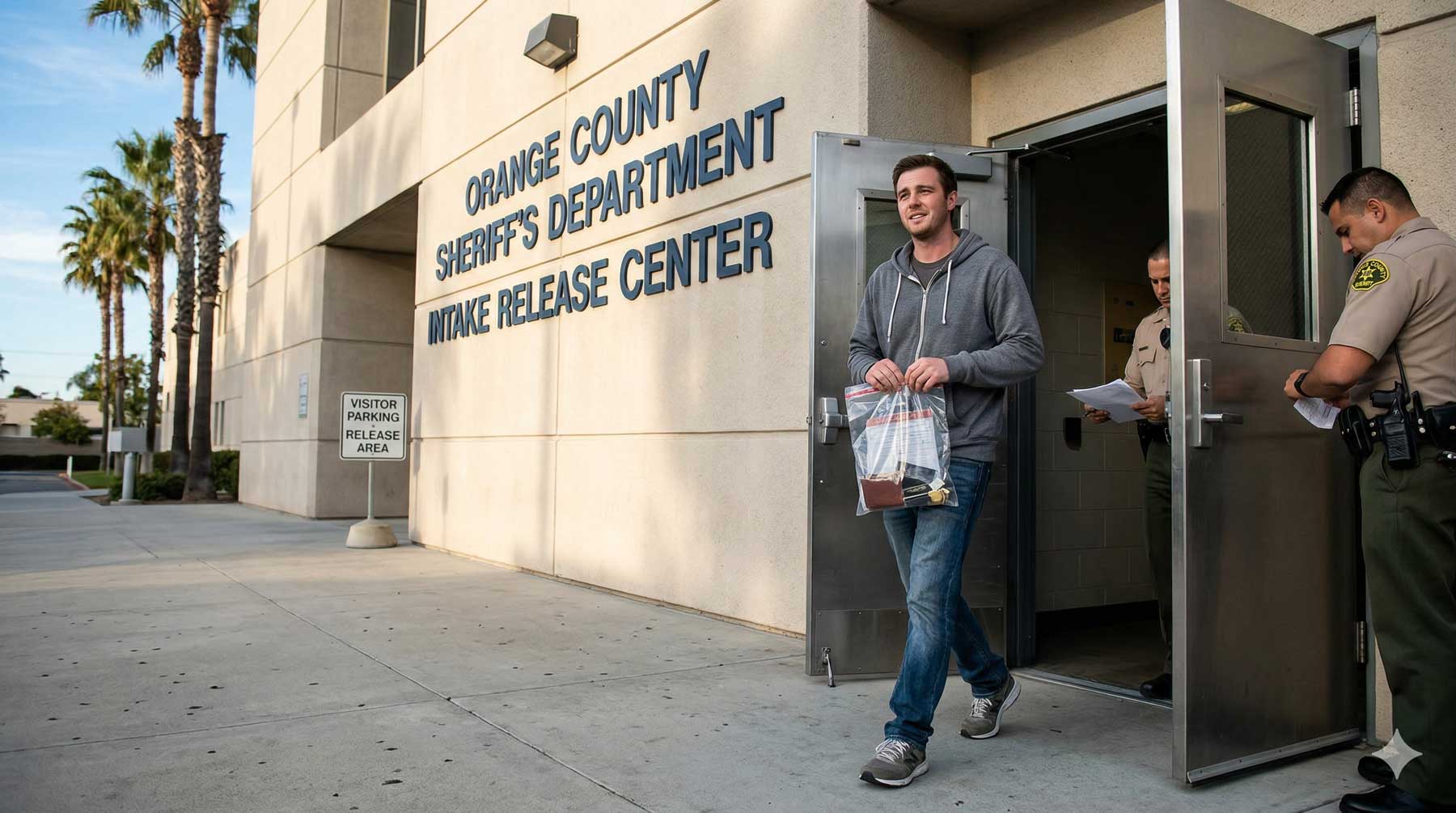
- Booking process begins: fingerprinting, mugshot, background check for warrants or criminal history
- You are assigned a booking number
Under California’s implied consent law (Vehicle Code 23612), you are required to submit to a chemical test after a lawful DUI arrest. This is typically a breath test at the station or a blood test at a medical facility. Officers must administer this test within three hours of driving.
What You Can Expect in the First 24 Hours
Most first-time DUI arrestees in Orange County — especially those without aggravating factors like accidents, injuries, or extremely high blood alcohol content — are released within 24–72 hours. You will typically receive a citation with a future court date rather than being held long-term.
An important distinction: A DUI arrest is not the same as a DUI conviction. An arrest means law enforcement had reasonable cause to believe you committed an offense. You remain presumed innocent until proven guilty beyond a reasonable doubt in criminal court. The body-cam footage, chemical test results, and officer statements from this period become evidence that can later be challenged.
Attorney Anthony J. Nuñes has over 26 years of experience guiding clients through this stressful first 24–72 hour period in Orange County, helping them understand what comes next and how to protect their rights.
Your Rights at the Time of and After a DUI Arrest
The following is general educational information about constitutional rights — not individual legal advice for your specific situation.
Understanding your rights during and after a DUI arrest can significantly impact how your case unfolds. Here is what you should know:
The Right to Remain Silent
Under the Fifth Amendment, you have the right to remain silent after being placed in custody. While you must provide basic identification information (name, address, date of birth), you can politely decline to answer questions about where you were drinking, how much you consumed, or where you were coming from.
The Right to an Attorney
The Sixth Amendment guarantees your right to counsel. However, you will typically meet your public defender or private DUI attorney at your arraignment hearing — not at the roadside or during booking. You can and should request an attorney, but expect to wait until your first court appearance to speak with one.
Pre-Arrest vs. Post-Arrest Testing
This distinction matters:
| Test Type | When Offered | Can You Refuse? | Consequence of Refusal |
|---|---|---|---|
| Field Sobriety Tests | Before arrest | Yes (for adults) | Generally no direct penalty |
| Preliminary Alcohol Screening (PAS) | Before arrest | Yes (for adults) | Generally no direct penalty |
| Post-Arrest Chemical Test | After arrest | Technically yes | Automatic 1-year license suspension, enhanced jail time, evidence of “consciousness of guilt” |
Do’s and Don’ts After a DUI Arrest
Do:
- Remain calm and polite with the arresting officer
- Provide basic identification information
- Clearly state that you wish to remain silent
- Request to speak with an attorney
- Submit to the post-arrest breath or blood test
Don’t:
- Answer detailed questions about your drinking or whereabouts
- Consent to vehicle searches beyond what is legally required
- Argue or become confrontational with officers
- Assume that refusing the chemical test will help your case
The statements you make, test results obtained, and police report from this period often become the prosecution’s evidence. Attorney Anthony J. Nuñes reviews body-cam footage, police reports, and testing documentation to identify challenges to the prosecution’s case.
What Happens to Your Driver’s License After a DUI Arrest?
A California DUI arrest triggers two separate legal processes: the criminal case in court and a separate administrative action through the California Department of Motor Vehicles. Many people are surprised to learn these proceed independently of each other.
The Pink Slip: Your Temporary License
In most cases, the arresting officer will confiscate your California driver’s license at the scene and issue a pink “Notice of Suspension and Temporary License.” This pink temporary license allows you to continue driving — but only for 30 days from the arrest date.
The Critical 10-Day Deadline
You have exactly 10 calendar days from your arrest date to request a DMV Administrative Per Se (APS) hearing. This deadline is strict and includes weekends. Missing it typically means your license will be suspended automatically without any opportunity to contest the DMV action.
Key DMV Milestones:
- Day of arrest: Physical license seized, pink slip issued
- Within 10 days: Must request APS hearing with DMV
- Day 31 (if no hearing requested): Automatic DMV suspension begins
- If hearing requested: Temporary driving privileges may extend until hearing decision
Suspension Periods
The length of license suspension depends on your circumstances:
| Situation | Typical Suspension |
|---|---|
| First offense (BAC 0.08%–0.15%) | 4 months |
| First offense with refusal | 1 year |
| Second offense within 10 years | 2 years |
| Third or subsequent offense | 3+ years |
| Commercial drivers | May face additional FMCSA penalties |
After serving a portion of the suspension, you may qualify for a restricted license with an ignition interlock device, allowing limited driving privileges for work, school, or DUI education programs.
Important: Public defenders generally do not handle DMV administrative hearings — they focus solely on the criminal case. A private attorney can request the hearing within the 10-day window, subpoena the arresting officer to testify, challenge the DMV process, and question whether there was proper legal basis for the stop and arrest.
The Criminal Court Process After a DUI Arrest
While the DMV hearing addresses your driving privileges, a separate criminal court case determines whether you will face DUI charges resulting in fines, probation, jail time, or other penalties. In Orange County, DUI cases are typically heard at courts including the Central Justice Center in Santa Ana, Fullerton Courthouse, West Justice Center in Westminster, Harbor Justice Center in Newport Beach, and North Justice Center in Fullerton.
Arraignment: Your First Court Date
Your first court appearance is the arraignment hearing. If you are released on citation after arrest, this typically occurs 2–4 weeks later. If held in custody, arraignment must happen within 48–72 hours.
At arraignment, the following things happen:
- Formal reading of DUI charges under Vehicle Code sections like 23152(a) or 23152(b)
- Advisement of your constitutional rights
- Entry of your plea (guilty, not guilty, or no contest)
- Decisions about bail, release conditions, and your next court date
In many misdemeanor DUI cases, California court rules allow a private DUI attorney to appear at arraignment on your behalf without you being present. This can save you time off work and reduce stress.
The Pretrial Phase
After arraignment, your case enters the pretrial phase. This is where much of the substantive work happens:
- Discovery review: Your attorney obtains and analyzes the police report, body-cam footage, breath test or blood test results, and calibration records
- Motion practice: Filing motions to suppress evidence if the stop lacked probable cause or if testing procedures were improper
- Negotiation: Discussions with the prosecutor about reducing charges (potentially to “wet reckless” under VC 23103.5) or recommending lighter sentencing
Trial
Only a small percentage of DUI cases — roughly 5–10% — proceed to jury trial. However, trial remains an important option when the prosecution’s evidence is weak, testing procedures are questionable, or the circumstances surrounding the arrest suggest the stop was improper. If you plead guilty or are found guilty, the judge will impose sentencing consistent with California law and any negotiated plea terms.
Potential DUI Penalties and Long-Term Consequences
Penalties vary significantly based on prior DUI convictions, the facts of your arrest, and local court practices. The following is a general overview only.
First Offense Misdemeanor DUI
A first offense DUI conviction in California typically carries:
- Fines: $390–$1,000 base fine, plus penalty assessments totaling $2,000–$4,000
- Probation: 3–5 years of informal probation with specific probation terms
- DUI school: 3–9 month alcohol education program
- Jail: 48 hours to 6 months (often suspended or served through electronic monitoring)
- License suspension: 6–10 months, with possible restricted license and ignition interlock device
- Traffic safety requirements: May include community service or attendance at victim impact panels
Multiple Offenses and Aggravating Factors
Second offense and subsequent DUIs within 10 years bring enhanced penalties:
- Minimum 10–45 days jail (second offense)
- Mandatory 18–30 month DUI school
- 2–3 year license revocation
- Mandatory IID installation
DUI with injury under Vehicle Code 23153 can be charged as a felony, adding potential prison time, substantial restitution, and long-term consequences.
Beyond Criminal Penalties
A DUI conviction affects far more than your criminal case:
- Insurance: Premiums typically increase 3–5 times for several years
- Employment: Background checks reveal convictions; commercial drivers face especially severe consequences under zero tolerance law policies
- Professional licenses: Medical, legal, nursing, and other licensed professionals may face disciplinary action
- Immigration: Non-citizens may face visa complications or deportation proceedings for certain DUI-related convictions
A DUI stays on your California driving record for 10 years for purposes of determining penalties for any future offenses. It may appear on criminal background checks indefinitely unless expunged.
How an Experienced Orange County DUI Attorney Can Help
Handling both the DMV hearing and criminal court case simultaneously can be overwhelming — especially given the 10-day deadline to request your APS hearing. This is where experienced legal counsel makes a meaningful difference.
Immediate Tasks an Attorney Can Handle
- Request the DMV administrative hearing before the deadline expires
- Obtain the police report, body-cam footage, and chemical test results
- Advise you on what to expect and how to prepare
- Appear at arraignment and pretrial hearings on your behalf (in most misdemeanor cases)
Common DUI Defense Strategies
An experienced DUI defense attorney examines every aspect of your case:
- Challenging the traffic stop: Did the officer have reasonable cause to pull you over?
- Questioning test accuracy: Were breath test devices properly calibrated? Was the blood test handled correctly?
- Examining field sobriety tests: NHTSA studies show these tests have significant error rates, especially when medical conditions or uneven surfaces affect performance
- Investigating alternative explanations: Could medical conditions, medications, or rising BAC explain the results?
Early involvement allows an attorney to preserve evidence that might otherwise disappear — surveillance footage from nearby businesses, witness statements, or vehicle data.
A Broader Perspective
With over 26 years of experience in Orange County, Attorney Anthony J. Nuñes handles criminal defense alongside personal injury, immigration, family law, business law, and civil litigation. This breadth of experience helps him understand how a DUI arrest might affect not just your criminal case, but your job, professional license, or immigration status.
Frequently Asked Questions About DUI Arrests in Orange County
What happens after a DUI arrest in California?
A DUI arrest in California triggers two separate legal proceedings: a criminal court case and a DMV administrative action against your driver’s license. The criminal case typically begins with an arraignment 2–4 weeks after arrest, while the DMV process starts with a strict 10-day deadline to request an Administrative Per Se (APS) hearing.
What are your rights during and after a DUI arrest in California?
You have the right to remain silent under the Fifth Amendment and the right to an attorney under the Sixth Amendment. You must provide basic identification but are not required to answer questions about drinking or your whereabouts. Clearly state that you wish to remain silent and that you want to speak with an attorney.
Can you refuse a breathalyzer or chemical test during a DUI arrest in California?
Pre-arrest tests — field sobriety tests and the preliminary alcohol screening (PAS) — are voluntary for adults. The post-arrest chemical test is not. Refusing the post-arrest breath or blood test under California’s implied consent law (Vehicle Code 23612) carries an automatic one-year license suspension and enhanced penalties if convicted.
What happens to your driver’s license after a DUI arrest in California?
The arresting officer confiscates your license and issues a pink temporary license valid for 30 days. You must request a DMV Administrative Per Se (APS) hearing within 10 calendar days of your arrest or your license is automatically suspended on day 31.
What is the 10-day DMV hearing deadline after a DUI arrest in California?
The 10-day deadline is the window to request an APS hearing with the California DMV — 10 calendar days from the date of arrest, including weekends and holidays. Missing it means automatic suspension with no opportunity to contest. The Law Office of Anthony J. Nuñes handles both the DMV hearing and the criminal court case to ensure this deadline is met.
What are the penalties for a first-time DUI conviction in California?
A first-time DUI conviction typically carries $2,000–$4,000 in total fines, 3–5 years of informal probation, a 3–9 month DUI education program, and a potential jail sentence of 48 hours to 6 months. Your license faces a 6–10 month suspension with the possibility of a restricted license and ignition interlock device.
Can a DUI arrest affect your immigration status in California?
Yes. Certain DUI-related convictions — particularly those involving injury (Vehicle Code 23153), aggravated felonies, or controlled substances — can trigger visa complications, denial of naturalization, or deportation proceedings. Attorney Anthony J. Nuñes handles both criminal defense and immigration law in Orange County, evaluating immigration consequences before advising on plea negotiations or trial strategy.
If you have been arrested for DUI in Orange County — whether in Anaheim, Garden Grove, Fullerton, Santa Ana, Newport Beach, or surrounding communities — the Law Office of Anthony J. Nuñes is available to discuss your situation. With offices in La Mirada and Santa Ana, Attorney Nuñes is ready to help you understand what comes next and work toward the best possible outcome for your case. Call (714) 404-3131 to schedule a consultation.